
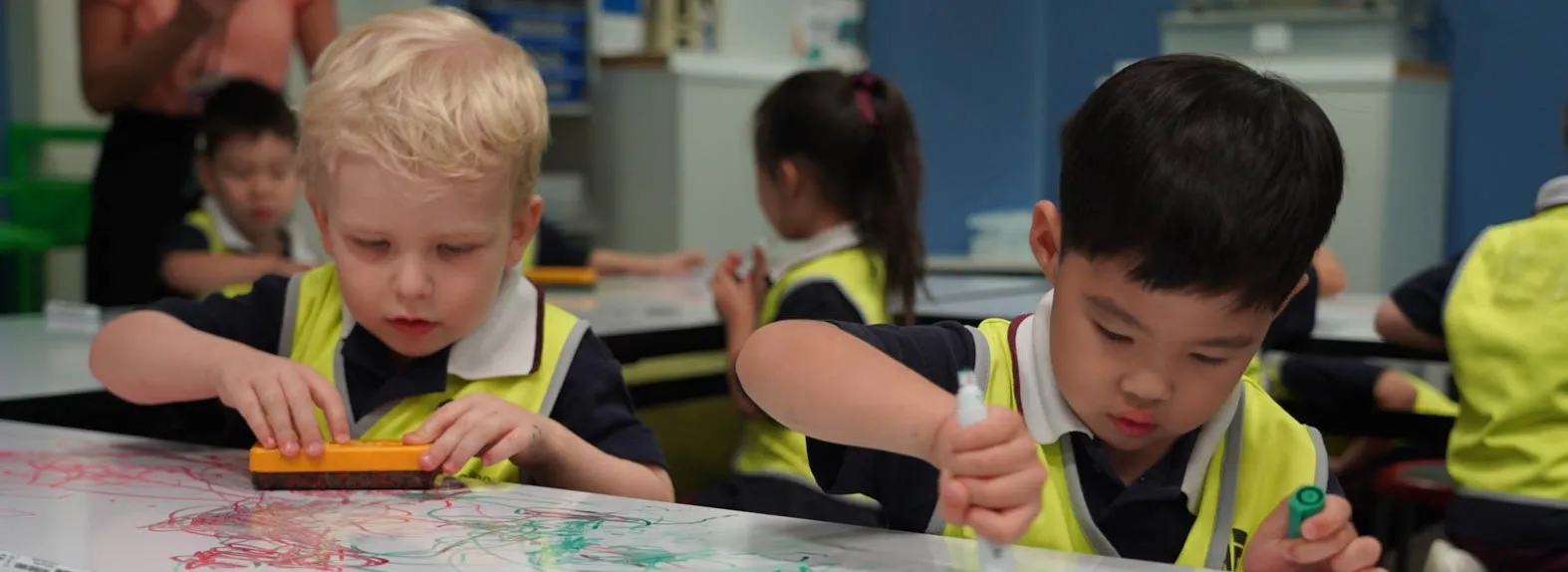
2.1 Welcome
Our Kindergarten is a learning environment where all children have the opportunity to reach their individual potential to live a contributing and fulfilling life. Our Kindergarten community grows in an environment where Christian Ecumenism is foundational, our values are embraced, and mutual respect encourages us to reach out and welcome those of all cultures and faiths. We acknowledge, respect, and celebrate the children's confidence and capabilities.
Image of the Child
We believe that all children have rights - a right to communicate, a right to be heard, a right to contribute and a right to learn.
We view children as competent, curious, natural researchers who are full of knowledge and potential, and interested in connecting to the world around them.
Our strong image of the child ensures that their 'voice', their culture, identity, and experiences are represented and reflected in the Kindergarten.
We believe that children should be nurtured to collaborate and communicate with others as they explore, experiment, hypothesise, take risks, create, imagine and interact in the environment.
Educational Program
Our program values building strong relationships with children and their families, promoting collaboration and communication among children, families, and staff.
We are committed to providing a variety of experiences (indoors and outdoors) that nurture children's spirit of inquiry, a lifelong love of learning and provide a foundation for becoming responsible citizens of the world.
The children's right to experience the joy of childhood is fundamental, and learning is promoted through play and emergent and intentional experiences and interactions. By providing blocks of uninterrupted time to play, children find inspiration, joy and gain a sense of wellbeing. Our engagement with the great outdoors empowers children to connect with nature, facilitating their social, spiritual, physical, intellectual and emotional learning.
We value the children's diverse ways of expressing themselves, and we will celebrate and document their learning to share with them, their families, and other colleagues.
We aim to provide a program that embeds sustainable practices to develop respect and appreciation for nature and the world around us.
A Community of Learners
We value families as the most important people in children's lives and engage in shared decision-making where children, parents and communities have a voice.
We acknowledge and value the traditional owners of the land our Kindergarten is situated on: the Yuggera Nation. We pay our respects to elders past and present by fostering learning and understanding of the Yugambeh people's culture and traditions within our daily program.
We recognise that our Kindergarten is part of the wider community, living and learning within John Paul College and promoting children's connectedness with the local community. We value reaching outwards, forming connections within the broader community and taking an active interest in what is happening around us.
As a team of Educators, we are committed to reflective practice and continuous quality improvement through reflection and collaboration. We engage in professional learning and dialogue to continually enhance the experiences for children and their families.
2.2 Queensland Kindergarten Learning Guideline
The Queensland Kindergarten Learning Guideline underpins our program and aims to enrich children's learning in the Kindergarten year.
The guideline is based on the Early Years Learning Framework for Australia (EYLF). It embraces the inclusive vision that 'all children experience engaging learning and build success for Life' (EYLF 2009). Throughout the Kindergarten Year, children's right to experience the joy of childhood is fundamental, and learning is promoted through play and emergent and planned learning experiences and interactions.
The guideline acknowledges children as competent and capable learners and adults' significant role in optimising and enhancing children's living and learning experiences. Adults and children share responsibility for the learning process through interaction, negotiation and collaboration.
International studies show that children learn and thrive in a warm, caring, play-based environment that includes parents in the learning process.
We believe that children do not learn in isolation; it is a collaborative process. The Kindergarten Learning Guideline acknowledges the essential role adults (educators and parents), other children and the physical environment play in children's learning.
The Kindergarten Learning Guideline - The guideline at a glance
The guideline describes five learning and development areas that relate to the five broad learning outcomes identified in the EYLF.
Identity
A Kindergarten child who has a strong sense of identity:
- is building a sense of security and trust
- acts with increasing independence and perseverance
- is building a confident self-identity.
Related EYLF learning outcome: Children have a strong sense of identity.
Connectedness
A Kindergarten child who is connected with and contributes to their world:
- is building positive relationships with others
- shows increasing respect for diversity
- shows increasing respect for environments.
Related EYLF learning outcome: Children are connected with and contribute to their world.
Wellbeing
A Kindergarten child who has a strong sense of wellbeing:
- is building a sense of autonomy and wellbeing
- explores ways to show care and concern and interact positively with others.
- explores ways to promote own and others' health and safety
- explores ways to promote physical wellbeing.
Related EYLF learning outcome: Children have a strong sense of wellbeing.
Active learning
A Kindergarten child who has a confident and involved learner:
- is building positive dispositions and approaches toward learning
- shows increasing confidence and involvement in learning
- engages in ways to be imaginative and creative
- explores tools, technologies and information and communication technologies (ICTs).
Related EYLF learning outcome: Children are confident and involved learners.
Communicating
A Kindergarten child who is an effective communicator:
- explores and expands ways to use language
- explores and engages with literacy in personally meaningful ways
- explores and engages with numeracy in personally meaningful ways.
Related EYLF learning outcome: Children are effective communicators.
The Importance of Play
John Paul College Kindergarten recognises the value and richness of play as a catalyst for children's learning and ongoing engagement in meaningful experiences. When children play, they approach experiences with interest, ownership, empowerment and possibility.
Through play at Kindergarten, your child is:
- recognised as competent and capable
- learning about and engaging in the community in which they live
- learning early literacy and numeracy skills and exploring the possibilities of technology
- exploring, interacting and appreciating the world around them
- actively engaged in negotiating and creating their own play environments
- building personal and emotional resilience, independence and self-confidence
- building increased control of their physical skills and learning about personal health and hygiene
- exploring relationships and developing friendships; listening to and appreciating the ideas and thoughts of others, developing social competence
- building an understanding and respect for their own and others' social and cultural heritage
- learning to share their knowledge and ideas with others through engagement and enjoyment in the learning process and representing their understanding and thinking in many ways
'If we remove play from children's lives, we remove a possibility for learning.'
Carla Rinaldi
2.3 Primary Years Programme
The Primary Years Programme (PYP) is integrated into the Kindergarten program. PYP is an international framework that ensures our students are prepared for the global world we live in today.
The PYP combines the best research and practice from various national systems with a wealth of knowledge and experience from international schools to create a relevant and engaging educational framework for all children. A driving force behind the PYP is a deeply held philosophy about the nature of international education and the development of international mindedness within each school community member.
The Learner Profile is central to the PYP definition of what it means to be internationally-minded and it guides schools towards a focus on learning. This profile is expressed in a series of desired attributes that create the PYP learner profile we all aspire to be.
The Learner Profile encompasses all that we do. We are...
Inquirers
Our natural curiosity has been nurtured. We are acquiring the skills necessary to conduct purposeful, constructive research. We actively enjoy learning, and this love of learning will be sustained throughout our lives.
Thinkers
We exercise initiative in applying thinking skills critically and creatively to make sound decisions and to solve complex problems.
Communicators
We receive and express ideas and information confidently in more than one language, including the language of mathematical symbols.
Risk-takers
We approach unfamiliar situations without anxiety and have the confidence and independence of spirit to explore new roles, ideas and strategies. We are courageous and articulate in defending what we believe.
Knowledgeable
We have spent time in our schools exploring themes that have global relevance and importance. In doing so, we have acquired a critical mass of significant knowledge.
Principled
We have a sound grasp of the principles of moral reasoning. We have integrity, honesty and a sense of fairness and justice.
Caring
We show sensitivity towards the needs and feelings of others. We have a strong commitment to action and service.
Open-minded
We respect the views, values and traditions of other individuals and cultures and are accustomed to seeking and considering a range of points of view.
Balanced
We understand the importance of physical and mental balance and personal wellbeing.
Reflective
We give thoughtful consideration to our own learning and analyse our personal strengths and weaknesses constructively.
The Curriculum Model
PYP is carefully guided inquiry learning - it is about discovering. PYP is concept-driven, focussing on the enduring understandings that children will take with them for life. PYP inspires children to WONDER and celebrate learning. Developing attitudes and expecting socially responsible behaviour are also essential elements of the program.
The Kindergarten children undertake four units of inquiry, investigating their world through the transdisciplinary themes of ….......
How We Organise Ourselves… How the World Works… How We Express Ourselves and Who We Are.
2.4 Guiding Children's Behaviour
It is our policy that all children and staff have the right to a safe environment.
At John Paul College Kindergarten, we create an environment that supports children's communication and interaction with others. Our goal is to develop children's self-control and responsible behaviour and support them as they learn to face the challenges and obligations of living. Staff use directional language, guidance, and behaviour-teaching processes to encourage children to understand and choose appropriate behaviour.
Guidance is an important concept in the area of behaviour. The goal of the guidance process is for the adult to interact with the child in a caring and understanding way, empowering and enabling the child to develop self-respect, self-responsibility and self-control. For example, if physical contact occurs between one or more children, staff will encourage the child to think about the child who has been hurt… 'How do you think the child you hurt is now feeling?' 'What could you do next time to solve the problem?' Children will be expected to take responsibility for their actions, which often looks like sitting with the child for a while to comfort them, holding ice on a bump, helping to rebuild something that was knocked down in the incident, etc.
When staff observe challenging behaviours, they make notes for the child's records to obtain a clearer picture. Staff try to establish reasons for a particular behaviour and plan experiences that will assist the child to:
- meet their needs in other ways, and
- learn the appropriate behaviour.
Families are consulted about any issues or concerns regarding their child's behaviour. Families are encouraged to collaborate with teachers to promote and guide positive behaviour with the child.
2.5 Inclusive Philosophy
John Paul College Kindergarten appreciates respect and encourages individuality and independence of all children, including those from culturally and linguistically diverse backgrounds and children with a disability or an additional need.
Children with Additional Needs
John Paul College Kindergarten provides an inclusive environment and program to meet the different and diverse needs of all children and their families accessing our service. Following an interview with the parent and child, the Head of Early Education and the Primary School Head, together with the parent/s, will discuss possible program plans and modifications where appropriate. Enrolment in the program will be based on the program the Kindergarten can offer that best suits the child's needs. The Head of Early Education will communicate with the Diverse Learning Coordinator at JPC and related services to make an appropriate funding decision. With funding, Kindergarten will arrange appropriate additional support and training for staff, families, and children as the need arises. Sharing information between the teaching team and the child's medical and support services is vital to support the child's total inclusion.
Cultural Diversity
John Paul College Kindergarten recognises and celebrates the multicultural nature of our community and aims to provide an environment and curriculum of acceptance towards all people. We value each child and family's culture and beliefs. All parents are encouraged to communicate any concerns or considerations with staff upon enrolment and daily,
Equity
The Kindergarten is committed to and firmly believes that experiences in the early childhood period have a significant impact on later childhood and adult life. John Paul College Kindergarten is a learning environment where all children are encouraged to engage in a range of experiences that promote their optimal development and give them the opportunity to reach their individual potential to live a contributing and fulfilling life.
2.6 Teaching Staff
Staff Positions
All staff working directly with children at John Paul College Kindergarten hold an appropriate early childhood qualification. The Early Education and Care requirement is that all permanent staff hold a current Senior First Aid and CPR certificate. All staff are trained in Child Protection, Asthma and Anaphylaxis. All staff working in the Kindergarten engaged in Regulated Employment are also required to hold a Working with Children Clearance (Blue Card) before commencing work.
Head of Early Education
- To ensure quality service delivery which provides young children with a secure and nurturing environment and serves to meet the needs of the community
- To be an advocate for children and children's rights
- To oversee the overall operation of the service
- To oversee the formulation of educational programs which are aimed at promoting the development of individual children, are developed in co-operation with parents and reflect the multicultural nature of our community
- To ensure a safe and healthy work environment for everyone
- To promote the Kindergarten to the local community
- To ensure that all communication is conducted professionally and courteously (including content, delivery and body language).
Early Childhood Teacher
- To formulate and deliver a high-quality, inclusive and educational program incorporating a play-based curriculum, which will provide children with a secure, nurturing environment
- To minimise stress in young children and their parents on separation from each other
- To develop an environment that is relaxed, home-like, aesthetically pleasing and safe for children and staff to live and work in
- To build rapport with families while encouraging partnerships.
Learning Assistants
- To maintain the environment and equipment in a safe, hygienic and aesthetically pleasing state
- To work as an effective team member
- To assist the teacher in the delivery of a high-quality, inclusive and educational program which will provide the children with a secure, nurturing environment
- To minimise stress in young children when separated from their families.
Staff Professional Development
Our Kindergarten believes that ongoing staff professional development is essential for high-quality practice. Professional development gives staff the opportunity to learn new skills and challenge current practice. We actively promote and support the ongoing professional development of all staff members by encouraging their attendance at courses, seminars, workshops and conferences. Staff are also encouraged to develop an ongoing approach to their own professional development.
2.7 Volunteers and Student Visitors
Occasionally, new faces will be in the Kindergarten when volunteers and students visit to gain experience in the education field. These new faces may also include relief staff, who are sometimes present at the Kindergarten.
Every visitor is interviewed by the Head of Early Education and provided with guidelines to ensure no disruption to the children's daily routine. The recruitment and management of volunteers within the Kindergarten is governed by the John Paul College Volunteer Management Policy and the Working with Children Policy.
Before a volunteer can be engaged in Regulated Employment, they must obtain and hold a valid, current Working with Children Clearance (Blue Card).
All visitors remain under the supervision of regular staff members and parents will be informed about visitors attending the Kindergarten.