
3.1 Governance and Management
John Paul College Ltd is the Approved Provider of John Paul College Kindergarten and is legally responsible for operating the centre.
A Nominated Supervisor, approved as a suitable, fit, and qualified person by the Regulatory Authority and appointed by the Approved Provider, oversees the centre's day-to-day operations.
Staff Information and rosters are displayed near the entrance to each classroom.
(Refer to Kindergarten Governance and Management Policy)
Nominated Supervisor: Leanne Zammit
The Kindergarten is regulated by the Department of Education, Training and Employment, Early Childhood Education and Care. The department is responsible for the Service Approval once it is assured that standards set under the Education and Care Services National Law Act 2010 and Regulations 2018 are being met. The address for the Office for Early Childhood Education and Care is:
Early Childhood Regulatory Authority | Metropolitan South Region | Coorparoo Office
PMB 250, MANSFIELD DC QLD 4122
Phone: (07) 3028 8063 | Email: Coorparoo.ECRA@qed.qld.gov.au
Contact Details
| Kindergarten | 07 3826 3450 / 3826 3300 |
| Outside School Hours Care - Kindergarten | 07 3826 3508 |
| Primary School Office | 07 3826 3300 |
| Early Learning Centre (ELC) | 07 3826 3444 |
| JPC Administration | 07 3826 3333 |
| Health Centre | 07 3826 3323 |
| Security | 07 3826 3338 |
From 8.15am - 3.15pm, all calls are made to the Office on 07 3826 3300. Calls will be transferred to the Kindergarten outside session times or if it is a matter of urgency. In all other cases, messages will be taken by the Office staff and they will pass these on to the Kindergarten staff.
Term Dates
Please click on the link for the current Term Dates.
3.2 Fees
| Five Day Fortnight Program | - Free for eligible families |
| Five Day Program | - $5,896 per year |
One full term's notice, in writing from parents, is necessary if, at any time, parents choose to remove their child from the College. If parents do not give notice of removal, JPC policy is to charge parents for the subsequent term's fees.
3.3 Educational Philosophy
The Italian city of Reggio Emilia is home to the world-renowned leader in Early Childhood Education. The Reggio Emilia Educational Project, highly regarded in the EYLF, places the individual child at the centre of its approach and has influenced the principles and practices of our Kindergarten learning environment at JPC.
3.4 Documentation
Documentation is a powerful tool for viewing the learning processes of both adults and children. Making learning, living and thinking visible immediately becomes a shared encounter: 'A collection of traces to be used at the end of the process for reflective purposes' (Rinaldi 2003). The documentation lets children and adults revisit their thinking, either together or on their own.
Individual Learning Journals
When we stop to ask children what they think, the possibilities abound. They are not only active seekers of knowledge but also ardent, and sometimes surprising, carriers of knowledge. At John Paul College Kindergarten, our professional staff strive to make this knowledge visible to you by capturing your child's learning and thinking in their learning journals. Learning Journals are more than a memory or keepsake of your child's time at Kindergarten. They not only provide insight into your child's learning, but also make the quality of our teaching practice visible to you. These learning journals are a collaborative effort and will be available to families and children. They give children an opportunity to revisit and reflect on past experiences, record their learning (including emerging literacy and numeracy skills), and help our teachers ensure your child's time with us is full of wonder and possibility.
You are encouraged to be a co-participant in three-way communication (i.e. child, parent and educator) and contribute photos, stories, artworks or any memorabilia that tells a story about your child's life and learning journey.
Documenting the Curriculum
As well as individual Learning Journals, the Educators at our Kindergarten will reflect the curriculum through a variety of documentation methods that could include observations that focus on social interactions, relationships, dispositions and learning processes; stories and conversation transcripts; video recordings, writing, drawing and painting, photographs of interactions, constructions and group projects, contributions from families.
Through these records that incorporate the voices of children and parents, we can visualise the thinking of both children and adults. The variety of documentation methods allows us to capture all the languages of children's expression.
Through careful observation, documentation and critical reflection, teachers gather information to determine the ideas and potential experiences that may emerge in this democratic learning forum. Our Kindergarten teachers adopt a reflective approach to planning, where planning formats are open-ended, retrospective, and shared, and planning decisions are tentative, flexible, and open to possibility.
Planning is a continuous, collaborative process within the program, as children and adults create opportunities for living and learning through spontaneous, unpredictable encounters in the here and now of every context. Our teachers will support children to become involved in what is interesting and meaningful to them.
Parents and guardians are invited to discuss the activities and experiences of our learning programs and the goals to be achieved through our curriculum.
Please ask the Teacher or Head of Early Education for more detailed information about your child's learning and development and how we collaborate to foster your child's learning opportunities.
3.5 Keeping Our Children Happy, Healthy and Safe
Protecting our greatest asset
As most parents know, a healthy child is a happy child, and at John Paul College Kindergarten, we do everything we can to make sure children are happy, healthy, and safe. Whether this is helping them cope when they are dropped off in the morning, making sure they have their hat on during outdoor sessions or knowing what to do if they have an allergic reaction. Don't hesitate to tell us about anything that will make your child's day happy and safe.
Safety at Kindergarten
To help the Kindergarten maintain the highest safety standards, we ask parents to ensure gates and doors are closed behind them and that our 'No Smoking' policy is strictly followed.
Staff and children practise fire and other emergency evacuations once a month at the Kindergarten. Evacuation procedures are outlined in all rooms, with diagrams and steps to follow. Parents are encouraged to familiarise themselves with this information. During an emergency evacuation drill, we ask everyone in the Kindergarten to participate with the children and staff. All parents and visitors must cooperate with staff and follow directions to ensure a quick, safe evacuation.
Workplace Health and Safety
Your child's safety is of paramount concern to us. Daily, staff carry out routine procedures to ensure an optimal level of safety is maintained. Such procedures include raking sandpits to check for foreign objects, covering sandpits after use, emptying water trays when not in use, and checking equipment and the environment for wear and tear. Other safety procedures include:
- ensuring all poisons and dangerous items are kept in locked cupboards
- filling out incident report forms to document the injury
- training staff on accident and emergency procedures
- ensuring that safety devices are installed
- requiring all permanent staff to hold a current senior first-aid certificate.
Should you have a concern about any safety issue, please see the Head of Early Education.
Hygiene
To minimise cross-infection at the Kindergarten, several procedures are followed for the wellbeing of the children. Parents and children are requested to wash their hands on arrival and departure from the building. All children are required to wash their hands after toileting and before meals. Staff members wear disposable gloves when attending to a sick child or changing soiled clothing. Toys and equipment are disinfected regularly. Each child applies sunscreen under staff supervision. Staff members use a disposable cloth to assist the child if required.
Injuries
If a child sustains an injury at Kindergarten, first aid is delivered immediately, and the Head of Early Education is informed of the incident.
If a child is ill or has a minor accident, contact will be made with the parent and further instructions obtained. If the accident is serious, an ambulance will be called immediately, and parents advised accordingly.
Parents must leave all emergency telephone numbers with the Kindergarten, including the family doctor, and ensure an up-to-date record is available at all times.
All incidents are recorded, and parents are asked to sign these forms when staff inform them of the incident. If the incident is serious and/or requires a parent or medical assistance, a parent will be notified as soon as possible after the incident. Small knocks and scrapes will be reported to parents at afternoon collection time.
If a child requires ambulance transport to hospital, a staff member will accompany the child without a parent.
The Kindergarten adopts the John Paul College Emergency Procedures in emergency management, including Dial 6 protocols for medical emergencies.
Sun Care
The outdoor program is an important part of Kindergarten, and sun safety is paramount. Sun Safety Policy: Avoid sun exposure during the hottest part of the day. Children are still required to wear sunscreen and a hat when outside.
The John Paul College Kindergarten Sun Care Policy provided to parents outlines the detailed procedures for sun safety at Kindergarten. Parents must implement the measures outlined in this policy and complete the form either granting or denying permission for staff to apply sunscreen.
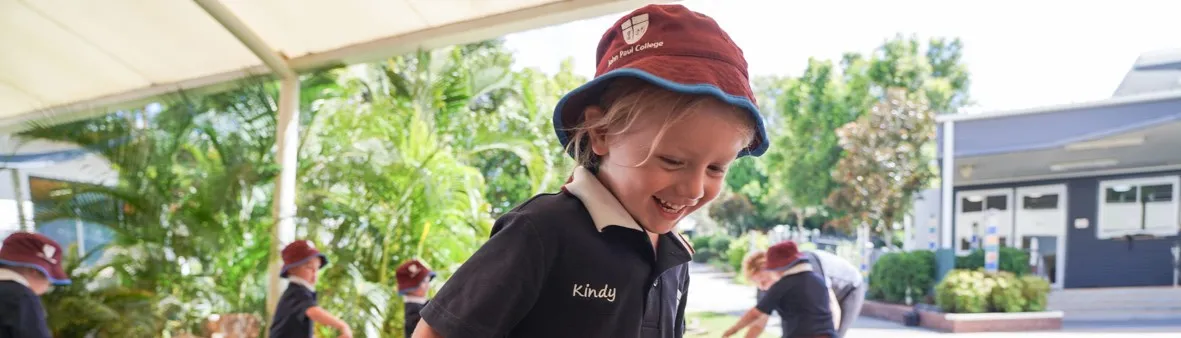
The Kindergarten provides an SPF 30+ sunscreen for the children's use. Parents who choose not to use the provided sunscreen are required to supply alternative sunscreen for their children. Children are required to wear the JPC bucket hat and the Kindergarten shirt is designed to provide adequate protection from the sun with the closed weave, collar and sleeves.
Health
The Kindergarten is committed to protecting the general health and wellbeing of children and staff by minimising the risk of infection spread within the Kindergarten. Dealing with sickness and infectious diseases is very serious, especially when so many children contact each other. Preventing the spread of infectious diseases is an important part of our commitment to protecting everyone's health and wellbeing.
By limiting attendance for sick and unwell children in Kindergarten, we can reduce the risk of infecting other children.
Children should not be brought to Kindergarten unless they can cope adequately with the program's normal daily routines and experiences. Usually, if you are in doubt, then they are not well enough to attend. It would be appreciated if children who are ill at home or appear to be sick are kept at home to recuperate.
Children who become ill during the day will be removed from the class to rest. Staff or the School Nurse will contact the parent/guardian immediately to collect the child from Kindergarten. Infection can spread quickly through a group; therefore, we ask parents to come to Kindergarten within the hour to collect their child.
Common concerns
If children show any of the following signs, parents are advised to keep them at home.
- Vomiting - If your child is suffering from vomiting, regardless of the cause, they must be kept at home for 24 hours from the completion of the vomiting attack. The exclusion can be for 48 hours if there is an outbreak.
- Diarrhoea - Regardless of the cause, children must be kept away from the Kindergarten for 24 hours, from the last attack, and have a normal bowel motion before they return. Exclusion may be 48 hours if there is an outbreak.
- Conjunctivitis - Children must be kept away from Kindergarten from when medical treatment starts until the discharge stops.
- Ear Infections - If there is a discharge, the child will need to be excluded.
- Colds - If children have any of the following symptoms, they need to stay home for a minimum of 24 hours or until they are well enough to cope with a normal Kindergarten day.
- thick green discharge
- a persistent or deep cough
- wheezing
- fever
- Listlessness or lack of appetite.
Medication
Suppose a child is required to take prescription medication during his/her attendance at Kindergarten. In that case, instructions from the child's Medical Practitioner or the attached pharmaceutical label must include the following information: the child's name, the name of the medication, the dosage to be taken, the frequency of dosage, the prescribing doctor's name, and the date issued. If this information is not on the label, we will not administer the medication.
Prescribed Medication
Parents are asked to enter the details of medication to be given on the 'Authority to Administer Medication Form' located inside the sign-on folder. The name of the medication as it appears on the bottle, dosage and time to be given must be entered on the form by the parent. Staff will not administer medication unless the parent indicates a specific time/dosage. The medication must be given to a staff member on arrival. The staff member will check the form and Medication with the parent to ensure all details are correct. Staff will place the medication in a locked storage bag inaccessible to all children or a locked bag in the fridge.
Non-prescribed medication (including alternative therapies)
Non-prescribed medication (i.e. over-the-counter medications and alternative therapies) will not be given to any child unless prior written permission and instructions from your child's doctor have been received by the Director or teacher.
Administering Puffers, Spacers and Nebulisers
The Kindergarten policy about puffers, spacers and nebulisers is as follows:
- All asthma medication must be administered according to the requirements of the Prescribed Medication in the Giving of Medication policy. A letter from the doctor or instructions as per the pharmacy label is required
- Parents must provide an asthma management plan for the child, which has been developed in consultation with the child's doctor, advising staff of the child's triggers, symptoms and appropriate management techniques
- A spacer must be used with a puffer for all children
- Nebulisers will not be administered more often than every four hours. If more frequent use is required, the child should not be attending the centre
- The doctor's letter must be renewed every three months if ongoing use is required.
- In the case of the child having an acute asthma attack or showing no improvement after the use of the nebuliser/puffer, the parent will be contacted, or the child will be taken to the hospital
- You are required to show the staff member the procedure for using the nebuliser so that both the staff member and child feel secure in using the machine
Please note: All medication must be given to a staff member on arrival. For the safety of children, under no circumstances should medication be left in the child's bag, on top of lockers, or in any other unsecured location. |
Immunisation
John Paul College Kindergarten supports the National Health and Medical Research Council recommendation that all children be immunised unless there is an apparent medical reason this should not occur.
Immunised Children
You must provide information about your child's immunisation status upon enrolment. A copy of your child's vaccination certificate or personal health record is required for your child's file.
Please note that parents are responsible for regularly updating the child's vaccination status by submitting new vaccination certificates after each immunisation.
All immunisation information for the following diseases must be kept up to date for school records:
- Diphtheria / Tetanus / Whooping Cough (Triple Antigen)
- Haemophilus influenza type b
- Poliomyelitis (Oral Polio Vaccine)
- Measles / Mumps / Rubella
- Hepatitis B
- Boosters as required.
Non-immunised children
John Paul College Kindergarten policy is to withdraw a non-immunised child from the Kindergarten during an outbreak of a vaccine-preventable disease until the outbreak has cleared. If your child is non-immunised, you will be required to complete an agreement to 'Withdraw a Non-Immunised Child' form stating that you will comply with this policy in the event of an outbreak of a vaccine-preventable disease.
The routine schedule of vaccines provided under the National Immunisation Program (NIP) is provided at the following link: National Immunisation Program.
If you have any questions regarding immunisation and vaccination, contact the School Nurse or your family GP.
Infectious Diseases
We use the National Health and Medical Research Council guidelines as our authority for the following exclusion times for communicable diseases.
If in doubt, please contact the College.
Please see below the current exclusions for illnesses and medical conditions.
https://www.health.qld.gov.au/__data/assets/pdf_file/0022/426820/timeout_poster.pdf
Parents are requested to observe the actions outlined in the exclusion poster if their children should contract any of these diseases. This list should be read in conjunction with NHMRC's publication Staying Healthy in Early Childhood Education and Care Services - 5th Edition.
The centre complies with Public Health Directives (such as for COVID-19) and adopts the John Paul College COVID-19 Infectious Disease Control Management Plan.
3.6 Child Protection Policy
John Paul College Kindergarten recognises that protecting students from harm and the risk of harm is fundamental to maximising their personal and academic potential. For this reason, the welfare and best interests of the children within our Kindergarten will always be a primary consideration.
We expect our students to show respect to our staff and volunteers and to comply with safe practices. We expect all employees to ensure that their behaviour towards and relationships with students reflect proper standards of care for students and are not unlawful. The Kindergarten will respond diligently to a report of suspected or actual harm or risk of harm to a student.
What does the Kindergarten mean by harm?
Recent Queensland legislation defines harm as:
'any detrimental effect of a significant nature on the child's physical, psychological or emotional wellbeing. It is immaterial how the harm is caused.'
Harm can be caused by:
- Physical, psychological or emotional abuse or neglect;
- Sexual abuse or exploitation; or
- Domestic or family violence.
How does Kindergarten protect students from harm?
The Kindergarten adopts the John Paul College Education and Care Services Child Protection Policy, which covers the actions to be taken if a member of staff or a parent of the Kindergarten becomes aware or reasonably suspects that harm has been done to a student of the Kindergarten by other staff, people outside the College or other students.
What should you do if you become aware or reasonably suspect that harm has been caused to a Kindergarten student by a member of staff, someone outside of the College or by other students?
You should report your concerns to the Head of Early Education or any other member of the Kindergarten staff.
What will happen next?
If you report your concerns to a staff member other than the Head of Early Education, that staff member will report it to the Head of Early Education immediately. If the complaint is about the Head of Early Education, the staff member will report it to the delegate of the Approved Provider - John Paul College Ltd. A report of a reasonable suspicion of harm will be made to the Department of Child Safety, Youth and Women (Child Safety) and/or other authority as required by law and policy.
What will the Head of Early Education and Department of Child Safety, Youth and Women (Child Safety) do?
If the Head of Early Education receives a report of harm or suspected harm to a student of the Kindergarten, and they become aware of the harm having been caused or reasonably suspect the harm to have been caused, then it will be reported to the police immediately if the harm relates to sexual abuse; or to the Department of Child Safety, Youth and Women (Child Safety) if appropriate.
The John Paul College Education and Care Services Child Protection Policy also governs reports required to be made to the Regulatory Authority pursuant to the Education and Care Services National Law Queensland. This includes, as relevant, any serious incident at the centre and other prescribed matters.
What happens about confidentiality?
Your report will be treated in a confidential manner and with respect.
Anyone with access to information about suspected or disclosed harm must maintain confidentiality. However, the Kindergarten cannot promise absolute confidentiality because the policy requires disclosing certain details, internally and externally, to respond to the report. State authorities can compel people to give evidence about actions under the policy and to produce documents. You would be fully informed that the information you provided would be shared with a third party.
Any action that needs to be taken under staff disciplinary procedures due to an allegation not requiring police/child safety or other regulatory intervention would be handled confidentially within the Kindergarten.
How will the Kindergarten help my child?
The Kindergarten will ensure that the following things are done to reduce the chance of harm occurring:
- Ensure that each staff member understands and fulfils their obligations under the John Paul College Education and Care Child Protection Policy for reporting abuse/ harm and other inappropriate or concerning behaviour.
- Ensure that there is an acceptable reference for each staff member engaged since their previous employer's commencement of this protocol.
- Ensure that each staff member and volunteer who has contact with children has a current Working with Children Clearance (Blue Card) as required by law and the John Paul College Working with Children Policy.
If the Head of Early Education receives a report of harm to your child, they will support the child by:
- responding rapidly and diligently to the report (internal and external to the authorities)
- reassuring the student
- protecting the child's confidentiality as much as possible
- offering continuous support
- providing counselling if requested.
What should I do if I require more information?
The John Paul College Education and Care Services Child Protection Policy adopted by the Kindergarten is available for access on the College website and at the Kindergarten. Parents and students may have access to this policy at any time. You may also make an appointment to discuss the policy with the Head of Early Education if you wish to clarify any matters.