

1.1 STATEMENT OF COMMITMENT TO THE PROTECTION OF CHILDREN AND YOUNG PEOPLE
John Paul College (JPC) supports children's rights and is committed to ensuring the safety, welfare and wellbeing of students. John Paul College is therefore committed to responding to allegations of student harm resulting from the conduct or actions of any person, including that of employees.
This commitment includes the provision of safe and supportive living and learning environments for all students and requires all employees, volunteers and visitors to model and encourage behaviour that upholds the dignity and protection of students from harm.
In support of this commitment, John Paul College is dedicated to the Child and Youth Risk Management strategy, which includes having relevant policies, procedures, and training to effectively address students' safety and wellbeing of students in our care.
1.2 Our Contribution to Society
An unwavering commitment to educate and develop exceptional individuals who courageously enrich society.
1.3 Our Purpose
Develop ethical, creative and service-oriented thinkers who thrive in a complex global environment.
1.4 Our Mission
To accelerate our dynamic learning community, igniting excellence in all.
1.5 Values and Ethos
At JPC, our core values of Mutual Respect, Integrity, Compassion and Excellence reflect our unwavering commitment to nurturing exceptional individuals who enrich society. Grounded in our Christian Ecumenical ethos, these principles are integral to our mission of accelerating a dynamic learning community, igniting excellence in all. By embodying these values, we foster a supportive environment that empowers students to contribute meaningfully to society, driven by respect, honesty, kindness and a relentless pursuit of excellence.
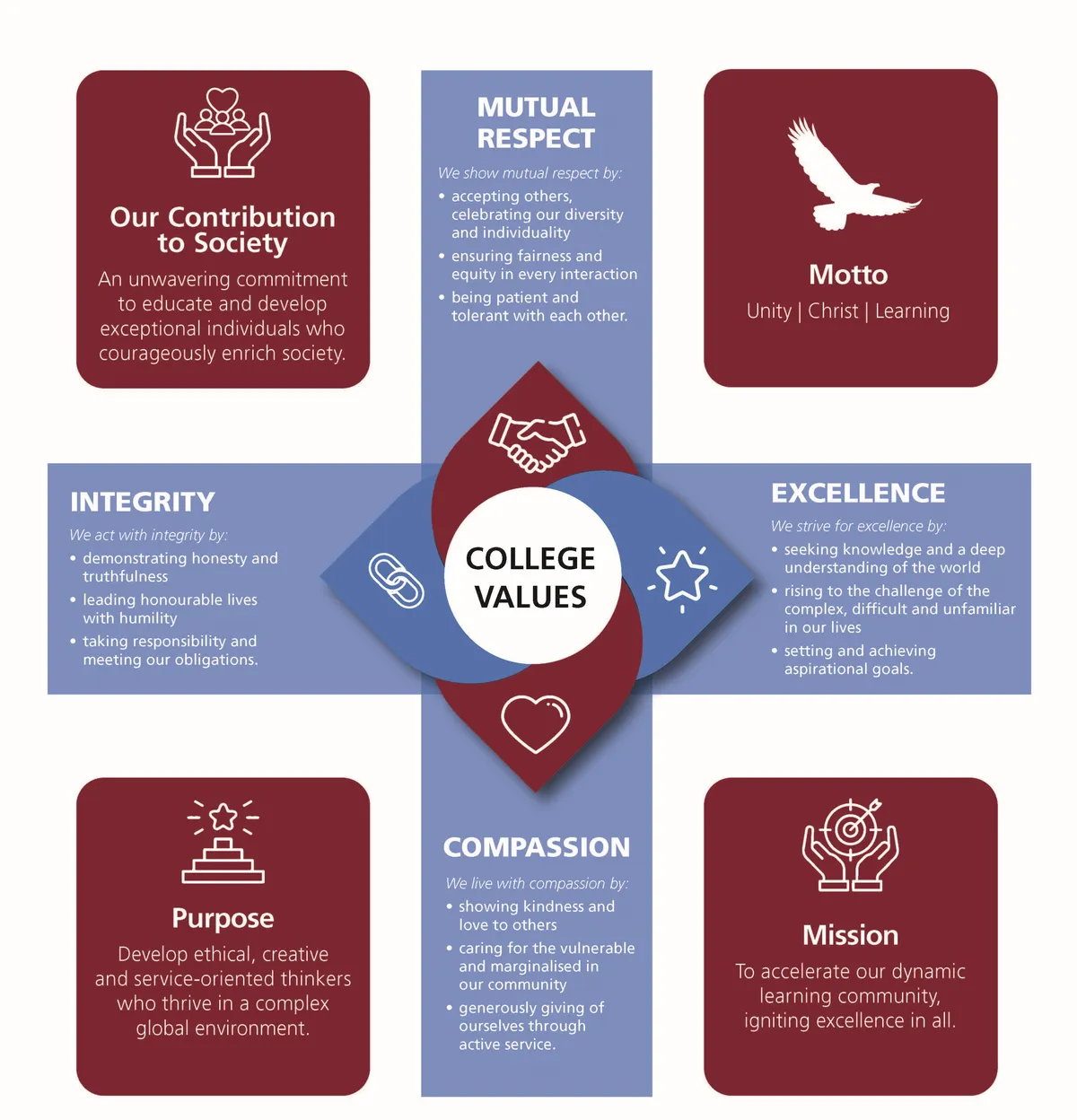
Text version of this image
College Values
- Mutual Respect – we show mutual respect by:
- accepting others, celebrating our diversity and individuality
- ensuring fairness and equity in every interaction
- being patient and tolerant with each other.
- Integrity – we act with integrity by:
- demonstrating honesty and truthfulness
- leading honourable lives with humility
- taking responsibility and meeting our obligations.
- Compassion – we live with compassion by:
- showing kindness and love to others
- caring for the vulnerable and marginalised in our community
- generously giving of ourselves through active service.
- Excellence – we strive for excellence by:
- seeking knowledge and a deep understanding of the world
- rising to the challenge of the complex, difficult and unfamiliar in our lives
- setting and achieving aspirational goals.
- Our Contribution to Society – An unwavering commitment to educate and develop exceptional individuals who courageously enrich society.
- Purpose – Develop ethical, creative and service-oriented thinkers who thrive in a complex global environment.
- Mission – To accelerate our dynamic learning community, igniting excellence in all.
- Motto – Unity | Christ | Learning
1.6 Unity in Christ
John Paul College was founded through a bold vision and an extraordinary commitment to Christian unity. In the late 1970s, Father Rollo Enright of St Peter's Parish, Rochedale, recognised the need for a Secondary School to serve the growing communities of Rochedale, Daisy Hill and Woodridge. When the Catholic Education Office was unable to support the proposal, he pursued an innovative alternative: establishing Queensland's first independent Christian Ecumenical college.
To bring this vision to life, Father Enright invited Father Leo Burke of St Edward's Parish, Reverend Patrick Doulin of St Mark's Anglican Church and Reverend Bryan Gilmour of the Uniting Church to join the Foundation Committee. United by a shared purpose, these four clergy leaders created a College founded on faith, learning and Christian unity.
John Paul College opened on 26 January 1982, becoming Queensland's first independent Christian Ecumenical secondary college. From the beginning, the College placed Christ at the centre of its community while fostering respect, understanding and collaboration across Christian traditions. This distinctive foundation continues to shape the College today.
In 1987, the College recognised the lasting contribution of its founding clergy by naming its Houses Burke, Doulin, Enright and Gilmour. These Houses honour four visionary leaders whose courage and collaboration established a school unlike any other.
Today, their legacy lives on through the College's motto, Unity | Christ | Learning, inspiring a community where faith is nurtured, diversity is celebrated and Christian unity is lived every day.
Christian Ecumenism
JPC is a Christian Ecumenical College. This means, firstly, that Christ and the Christian message are at the centre of the teachings, values and principles we espouse and, secondly, that we promote Christian Unity - that is, a united witness to the Good News of Jesus.
Our Christian Ecumenical College is one where our Christian Living program highlights what we have in common and celebrates our distinct ways of practising our faith.
Christian Ecumenism recognises that people from different Christian faiths and traditions can work together towards greater unity while preserving their own traditional faith and practice.
It does not seek to ignore these differences, but we aim to live in harmony and respect our differing beliefs through understanding and mutual respect.
We do not seek any change in practice that would be ahead of that recognised by the authority of the individual churches but promote adherence by every church member to the laws, traditions, and authority of his/her church while seeking that unity, Christ's prayer.
Our Christian Ecumenical philosophical approach to fellow Christians (of respect, understanding, tolerance and love) is easily and appropriately applied to those from other religious backgrounds and so they are welcome here also (with the knowledge that their children will be taught the Christian faith).
By being involved in Christian Ecumenism, we can celebrate our diversity whilst embracing our unity.
Consequently, we gain a new pride in ourselves within our own Christian beliefs and traditions whilst we all hold true to the gospel of Jesus Christ.
College Prayer
Heavenly Father, we give You thanks for our John Paul College Family.
May we strive to become more like Jesus Christ, who is 'our way, truth and life'.
Help us through Your Holy Spirit to be compassionate, kind and forgiving to each other.
Enable us to serve one another with humility and patience, and over these virtues let us strive to live in peace and love.
Guide us all safely through each day. May this College be a light to the nations.
In the name of Jesus Christ, we pray.
Amen
College Hymn - We Are Family
We are heirs of the Father,
We are joint heirs with the Son,
We are children of the Kingdom,
We are family, we are one.
We are washed, we are sanctified,
We are cleansed by the blood,
We are born of the Spirit,
We are family, we are one.
We are members His body,
We are objects of His love,
We’re partakers of His holiness,
We are family, we are one.
1.7 College crest, Symbol and Motto
 | The College crest portrays, in visual terms, the values and ideals which the College upholds and which all students are encouraged to follow. The crest is the shape of a shield, reminding us of St. Paul's words, "So stand ready, with truth as a belt tight around your waist, with righteousness as your breastplate, and as your shoes the readiness to announce the Good News of peace. At all times, carry faith as a shield." (Ephesians 6:14-16) At the centre of the shield is the cross, the central symbol of Christianity. It reminds us that Christ died and rose from the dead out of love for us, and that this love must remain at the centre of our lives. |
The openings at all ends of the cross indicate that, through Christ, we must reach out to others with the same love Christ shows his followers.
On one side of the cross is a bundle of sticks which have been tied together. Because it is much harder to break a bundle of sticks than a single stick, this symbol reflects the values of Christian Ecumenism, which promotes Unity among all Christian denominations. Christianity, therefore, gains strength from a united witness. As a consequence of this Christian Ecumenical practice, we are all challenged to foster peace, harmony and unity among all humankind. On the other side of the cross is an open book. This is a symbol of Learning which is the 'raison d'etre' of the College. This book has emblazoned on it the first and last letters of the Greek alphabet (the Alpha and the Omega), which remind us that Christ is the beginning and end of all learning.
It carries the profound obligation to prepare students to lead a life of compassion in service to others. It offers a model of education, professionalism, leadership, and living that is not merely about enriching the self but about commitment to the welfare of our shared humanity.
The Eagle is a symbol of spirit, vision, strength, and courage. It is considered to be the king of the air and the messenger of the highest Gods. As a Christian symbol, the eagle represents salvation, redemption and resurrection. The eagle seems to ascend the skies easily and is held to represent a noble nature because of its strength and aristocratic appearance. 'But they that wait upon the Lord shall renew their strength; they shall mount up with wings as eagles; they shall run, and not be weary; and they shall walk, and not faint.' (Isaiah 40:31)
 | A lesson to be learned from the eagle is not to depend exclusively on intellectual solutions. Through its connection to the air element, the eagle is connected to intelligence, but also to the Spirit, the knowledge that goes far beyond intellect. In an image of the eagle, the wings signify protection, and the gripping talons symbolise ruin for evildoers. Despite its enormous size, the eagle still takes flight seemingly effortlessly. This symbolic cue is the epitome of John Paul College aiming to provide the 'wind beneath the wings' of its students so that they can 'soar like eagles'. Not all students can be leaders, and not all leaders will succeed, but we must not let the illusion of limitation ground us in our flight. |
The eagle teaches us to courageously face our fear of the unknown, so we are then able to fly as high as our heart's joy can take us; to soar. As members of the John Paul College family, we must let go of our limited perspectives and release ourselves from comfortable, familiar thought patterns, because flying into a larger world requires the bravery to enter unknown realms.
The College crest symbolically reflects the philosophy and religious values that underpin the John Paul College Mission Statement and are reflected in the College motto: Unity | Christ | Learning. College colours are burgundy and blue.
1.8 Houses
John Paul College has a long-standing tradition of competitiveness and loyalty to interhouse competition. Whether you bleed blue for Gilmour, turn green for Doulin, get energetic with Enright, or be the best in Burke, our students’ loyalty and commitment to their colours extend well beyond graduation and into the next generation of JPC students.
While the flags of Burke, Doulin, Enright and Gilmour are displayed around campus, did you know these names weren't the original house names?
In its foundation year, John Paul College, along with its 144 students and nine staff, established its first interhouse competition. Named after cities from ancient Israel, Cana (gold), Bethel (red), Galilee (green) and Nazareth (blue) were the very first house groups in the College’s history.
In 1987, the College renamed the houses in honour of the Founding Clergy, who pioneered the movement to establish a Christian Ecumenical Secondary School in Daisy Hill. Father Leo Burke of St Edward’s Parish (Daisy Hill), Father Patrick Doulin of the St Mark’s Anglican Church (Daisy Hill), Father Rolo Enright of St Peter’s Parish (Rochedale) and Reverend Bryan Gilmour of the Uniting Church were all members of John Paul College’s foundation committee.
When the original founding committee learned the Catholic Education Office could not support the proposal for a Catholic Secondary School in Daisy Hill, Father Rolo Enright floated the very radical idea of establishing Queensland’s first Independent Ecumenical College. When this motion was unanimously decided, Father Rolo Enright and Father Leo Burke invited Father Patrick Doulin and Reverend Bryan Gilmour to join the foundation committee and form the concept of John Paul College – a Christian Ecumenical Secondary School in Daisy Hill.
So, while we celebrate the many achievements of our interschool houses, we also celebrate their origins and how they were established. Whenever you see the white, red, green, or blue flag soaring high, remember it honours the four great men who turned the dream of an Ecumenical College in Daisy Hill into reality.
House Allocation
The Admissions Manager allocates students to one of four Houses: Burke (Red), Doulin (Green), Gilmour (Blue) and Enright (White). They remain in the same House throughout their schooling, and all children in the same family will belong to the same House. Parents are invited to attend the various interhouse competitions and carnivals throughout the year. These are detailed in the College calendar. Houses are organised by nominated staff as House Patrons.
1.9 The Primary Years (PYP) International Baccalaureate (IB) Programme
The PYP IB programme aims to develop inquiring, knowledgeable and caring young people who help create a better and more peaceful world through intercultural understanding and respect.
All IB programmes aim to develop internationally minded people who, in recognising their common humanity and shared guardianship of the planet, help create a better and more peaceful world.
1.10 Acknowledgement of Country
Our College recognises the continuing connection of Aboriginal and Torres Strait Islander peoples to the country we live, work, learn and grow. All staff and students have the opportunity to show respect to Traditional Owners and Custodians by regularly conducting an Acknowledgement of Country at meetings and events throughout the year.
The John Paul College community acknowledges the Yugambeh and Yuggera peoples as the Traditional Custodians of the land on which we live, learn, work and play. We pay respect to Elders past and present, for they hold the memories, traditions, cultures and hopes of First Nations peoples, inspiring our commitment to sustainability and innovation.